·
10 minute read
Say you run a county scholarship. Three hundred students applied this year, and your committee of five volunteers has two weeks to pick ten winners. On page two of every application sits a question someone added years ago: What does your parent do for a living? Nobody on the committee scores it. Nobody remembers why it's there. But 300 students answered it, and now you're storing their answers.
Your application form does two jobs. It tells students whether to apply, and it tells your reviewers who to pick. Every question should feed one of those decisions. When a question doesn't, it costs students time, takes your reviewers' attention, and leaves you holding data you don't need.
Your applicants have changed too. Nearly all U.S. teens (95%) have access to a smartphone, according to Pew Research Center. More than half (54%) have used an AI chatbot for help with schoolwork, according to a 2026 Pew report. So expect your form to be opened on a phone, and expect some applicants to try your essay prompt in a chatbot.
Below are five scholarship application templates you can view, a free core template you can copy today, and what to update on your form for 2026.
What Makes a Good Scholarship Application Template?
A good scholarship application template covers five things: eligibility, applicant information, essays, recommendations, and, for need-based awards, financial need. Every question on it confirms eligibility, reaches the student, or maps to a criterion your committee scores. If a question does none of those, cut it.
Back to the county scholarship. If your committee scores GPA, an essay, and a recommendation, those sections are the core of your form. Everything else is there to confirm eligibility or to reach the student. Our list of scholarship application template mistakes to avoid shows what else to cut.
What Are the 5 Best Scholarship Application Templates?
The five best scholarship application templates are an eligibility-first application, an essay and recommendation application, a complete general-purpose application, a need-based application, and a basic starter form. Each one handles a different part of the form well.
Here's how the five compare:
|
Template |
Best for |
What to copy from it |
|---|---|---|
|
Template #1 |
Programs with firm eligibility rules |
Eligibility up front, award rules, and auto-scored qualification questions |
|
Template #2 |
Programs that weigh essays and references |
Recommender instructions, essay prompt directions, and writing tips |
|
Template #3 |
A complete, general-purpose application |
The full flow from Applicant Information to Household Financial Information |
|
Template #4 |
Awards based on financial need |
Assets, income, expenses, debt, and resources sections that use Calculations |
|
Template #5 |
New programs starting from scratch |
A basic form you can extend |
Pick the template closest to your criteria, then borrow sections from the others.
Template #1: Eligibility-First Application
Template #1 puts the eligibility requirements at the very start, so students who don't qualify find out before they type a word. It also spells out what can cost a recipient the award. And it uses qualification questions with Autoscoring (Enhance and Enterprise plans), which helps your evaluators filter out less-qualified applicants early.
View Template #1: eligibility-first application
Use it when your rules are firm: a GPA floor, a county, a major. Write each rule as a yes-or-no question a student can answer in seconds. For the county scholarship, that's one question: Do you live in the county? A no ends the application there, and nobody spends an evening on an essay you can't fund. Our post on criteria for evaluating scholarship applications can help you decide which rules to set.
Template #2: Essay and Recommendation Application
Template #2 is the one to study for its recommendation and essay sections. The instructions are clear for both the applicant and the recommender, and the essay section gives direct prompt guidance and writing tips.
View Template #2: essays and recommendations
This one earns its place when essays and references carry real weight in your scoring. Tell recommenders exactly what you want them to address, because a vague request gets you a vague letter. Ask a teacher to describe a time the student took on something hard, and your reviewers get a story they can score. Ask for "a letter of support," and they get a general letter that's hard to score. We cover the logistics in managing scholarship recommendation letters.
Template #3: Complete General-Purpose Application
Template #3 shows a complete application from start to finish. It runs from Applicant Information through Household Financial Information and mixes short-answer and multiple-choice questions.
View Template #3: complete application
Treat it as your reference for overall flow. Notice where it uses multiple choice: those answers are quicker for students and easier for you to score. Our guide on how to build your scholarship application goes deeper on question design, and best practices for building scholarship application forms covers layout.
Template #4: Need-Based Application
Template #4 is built for programs that award on financial need. Its key sections are Family Assets, Income, Student's Projected School Expenses, Student Debt, and Projected Student Resources for the Academic Year. It uses the Calculations feature to total the numbers on the form, so you skip the side spreadsheet.
View Template #4: need-based application
This is where income questions belong: on a form where need is a scored criterion, not a tiebreaker. Ask only for the figures your committee will compare. For the rest of the process, see how to manage need-based scholarships.
Template #5: Basic Starter Form
Template #5 is a basic form, and that's the point. It gives you a clean, flexible starting place for building your own.
View Template #5: basic starter form
It fits best when your program is new or your criteria are simple. Start with it, and add a section only when your rubric needs one. If your program is built around a mission statement, see 3 templates for vision and mission driven scholarship programs.
What Questions Should a Scholarship Application Include?
A basic scholarship application should include eligibility questions, applicant contact information, academic information, one essay prompt, recommendation instructions, a financial need section only if need is scored, and a signed certification that the answers are true.
Copy the core template below into your own form. Replace anything in [brackets] with your program's details, and delete any section your committee won't score.
Free Core Scholarship Application Template
Section 1: Eligibility (answer yes or no)
- Do you live in [county or service area]?
- Will you be enrolled at least half-time at an accredited college, university, or trade school in [award year]?
- Do you have a cumulative GPA of [3.0] or higher?
- [If required] Do you plan to study [field or major]?
If any answer is no, show this message: "Thank you for your interest. Based on your answers, you aren't eligible for this scholarship this year."
Section 2: Applicant information
- Full legal name and preferred name
- Email address
- Mobile phone number, and whether we may text you about your application
- Mailing address
- Current high school or college
- Expected graduation date
- College or school you plan to attend, if known
Leave off Social Security numbers and anything else your committee won't score. If you need them, collect them from recipients after selection.
Section 3: Academic information
- Cumulative GPA and the scale it's on (for example, 4.0)
- Upload your most recent transcript (an unofficial copy is fine)
- Intended major or field of study
- [Only if your rubric scores them] Test scores
Section 4: Essay
- Prompt: "In 300 to 500 words, describe a challenge you took on and what you learned from it." [Replace with a prompt tied to your program's purpose.]
- What reviewers look for: [for example, specific examples and a clear connection to your goals]
- AI use: "You may use AI tools to check spelling and grammar. The ideas and the writing must be your own." [Replace with your program's rule.]
Section 5: Recommendation
- Recommender's name, email address, and relationship to you
- Message to the recommender: "Please describe a specific time this student showed [the quality your program rewards]. Your response is confidential and goes to the selection committee."
- Due date: [at least one week before the application deadline]
Section 6: Financial need (include only if need is scored)
- Student Aid Index (SAI) from your FAFSA Submission Summary (allow negative numbers down to -1,500)
- Household size
- Other scholarships or grants you've been awarded for [award year], and their amounts
- Optional: anything about your financial situation the committee should know
Section 7: Certification
- "I certify that the information in this application is true and complete. I understand that false information may disqualify me or require me to return the award."
- Typed full name and date

What Should You Leave Off a Scholarship Application?
Leave off a scholarship application any question your committee doesn't score and any sensitive data you don't need, starting with Social Security numbers. Every extra field costs applicants time and gives you one more thing to protect.
|
A note from Robert I've been CEO of SmarterSelect for 19 years, and I've seen a lot of applications. My advice: leave off the background and personal questions that don't fit your program's criteria, like a parent's employer, or income when the award isn't need-based. Nobody ever scores them. Robert Davis, CEO and Founder, SmarterSelect |
That's the parent's-occupation question from the county scholarship. If it isn't on the rubric, it comes off the form. Income works the same way. On a need-based form like Template #4, it's the center of the application. On a merit award, it's data you collect and never use.
The Federal Trade Commission is blunt about sensitive data. If you don't have a legitimate need for sensitive personal information, don't collect it, and use Social Security numbers only for required and lawful purposes. If you do need a Social Security number later, collect it from recipients after selection, not from every applicant.
Wrong answers are the other half of this problem. Our posts on handling inaccurate scholarship application responses and common scholarship application errors cover how to catch them.
What Should You Update on a Scholarship Application in 2026?
Update four things on a scholarship application in 2026: FAFSA terms, essay instructions, the phone layout, and accessibility. None of them needs a redesign. Each is a small edit, and students notice when it's missing.
|
What to check |
The fact |
The fix |
|---|---|---|
|
FAFSA terms |
The Student Aid Index (SAI) replaced the Expected Family Contribution (EFC) starting with the 2024-25 award year. |
Relabel any EFC field as SAI. |
|
Essay instructions |
54% of U.S. teens have used an AI chatbot for help with schoolwork. |
Put your AI rule in writing next to the prompt. |
|
Phone layout |
95% of U.S. teens have access to a smartphone. |
Complete your own form on a phone before you publish it. |
|
Accessibility |
Public colleges and other state and local government entities must meet WCAG 2.1 Level AA by April 26, 2027 or April 26, 2028, depending on size. |
Test the form with a keyboard and a screen reader. |
One detail on SAI trips people up. The SAI can be a negative number, as low as negative 1,500, according to the U.S. Department of Education. If your field only accepts zero or higher, your neediest students can't enter their real figure.
For the county scholarship, the phone test is the cheapest fix on this list. Fill out your own form on a phone, start to finish, before you open it. If you get stuck on the transcript upload, so will 300 students.
WCAG 2.1 Level AA is the technical standard for accessible web content: a student using a screen reader or only a keyboard has to be able to finish your form. The Justice Department set the compliance dates in an interim final rule on April 20, 2026. That rule doesn't cover private providers, though other disability laws may apply. Treat WCAG 2.1 AA as your target and ask counsel what applies to you.
What Does the IRS Expect From a Private Foundation's Scholarship Application?
The IRS expects a private foundation's scholarship selection process to be objective, nondiscriminatory, and approved in advance under IRC Section 4945(g), requested on Form 8940. Without that approval, the IRS can treat the awards as taxable expenditures, which triggers excise taxes.
The IRS looks at three things:
- The applicant pool. The group you choose from has to relate to the scholarship's purpose and be large enough to count as a charitable class.
- The criteria. What you score has to tie back to that purpose, such as grades, test results, recommendations, financial need, or an interview.
- The selectors. The people who pick recipients can't be in a position to gain a private benefit from the choice.
Your form is where those criteria become questions. If a question doesn't map to a stated criterion, it's hard to defend, which is one more reason the parent's-occupation question has to go.
This rule is for private foundations. If you're a public charity or a school, run your own requirements by counsel.
How SmarterSelect Helps
A template gets you a form. It doesn't get you through the season.
Without one system, the season tends to go the same way every year. Transcripts arrive as phone photos. Recommendation letters land in three different inboxes. Someone retypes GPAs into a spreadsheet the night before the committee meets.
We built our scholarship management system so you don't have to run it that way:
- Copy a proven form. Our Program Library gives you application forms you can copy, so you're editing instead of drafting.
- Screen at the door. Pre-Qualify Applicants asks your own qualifying questions first, which helps keep ineligible students out of your review pile.
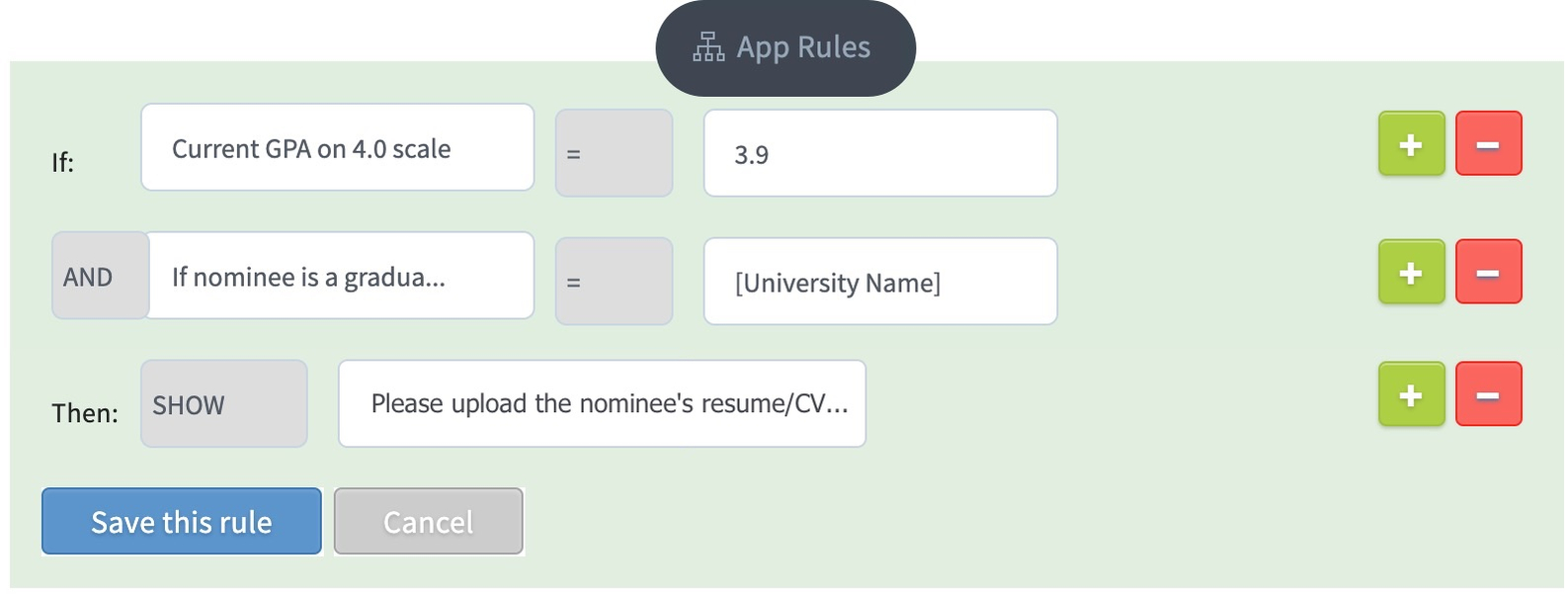
- Show only what applies. On Enhance and Enterprise, App Rules (If/Then Questions) change the questions based on earlier answers, so a first-year student skips the transfer page.
- Let the form add. Calculations total income, expenses, and scores on the form itself, which cuts down on math errors.
- Collect letters online. On Enhance and Enterprise, Online Recommendations send your questions straight to the recommender, and the answers attach to the right application.
- Score the measurable answers. On Enhance and Enterprise, Autoscoring assigns points to GPAs, test scores, and set answers, so reviewers don't hand-score them.
Every plan includes unlimited programs, so each scholarship can have its own form. Our plans and pricing are on one page, with no platform setup fees.
Want to build this template in SmarterSelect? Schedule a demo and we can set you up with a free trial to try it with your own criteria, or see how SmarterSelect works.
FAQs
How do you write a good scholarship application template?
To write a good scholarship application template, start from your selection criteria and work backward. List what your committee scores and write one clear question for each item. Put eligibility first, keep instructions short, and fill out the form yourself on a phone before you open it.
What are the elements to consider while developing a scholarship program?
A scholarship program has five elements to consider: the award amount, the funding source, the selection method, the award frequency, and the application form. Settle the first four before you write the form. Our ultimate scholarship management guide covers the full process.
What should you not ask on a scholarship application?
Don't ask for anything your committee won't score or that you don't need to run the program. That includes Social Security numbers at the application stage, a parent's employer, and income on awards that aren't need-based. If you need sensitive details, collect them from recipients after selection.
Can students use AI to write scholarship essays?
Whether students can use AI on a scholarship essay is up to you as the provider. State the rule next to the prompt. More than half of U.S. teens (54%) have used an AI chatbot for schoolwork help, so silence isn't a policy (Pew Research Center, 2026).
Do scholarship applications have to be accessible?
Online scholarship applications from public colleges and other state and local government entities have to meet WCAG 2.1 Level AA. The compliance date is April 26, 2027 for entities serving 50,000 or more people, and April 26, 2028 for smaller ones (Department of Justice interim final rule, April 20, 2026). That rule doesn't cover private providers, though other disability laws may apply, so WCAG 2.1 AA is a sensible target.
Sources and References
- Pew Research Center. How Teens Use and View AI, February 24, 2026.
- Pew Research Center. Teens and Internet, Device Access Fact Sheet.
- U.S. Department of Education. FAFSA Simplification Fact Sheet: Student Aid Index (SAI).
- U.S. Department of Justice. Interim final rule extending the ADA Title II web accessibility compliance dates, 91 FR 20902, April 20, 2026.
- Internal Revenue Service. Private foundations: Selection of grantees on an objective and nondiscriminatory basis.
- Internal Revenue Service. Grants to individuals.
- Internal Revenue Service. Advance approval of grant-making procedures.
- Federal Trade Commission. Protecting Personal Information: A Guide for Business.